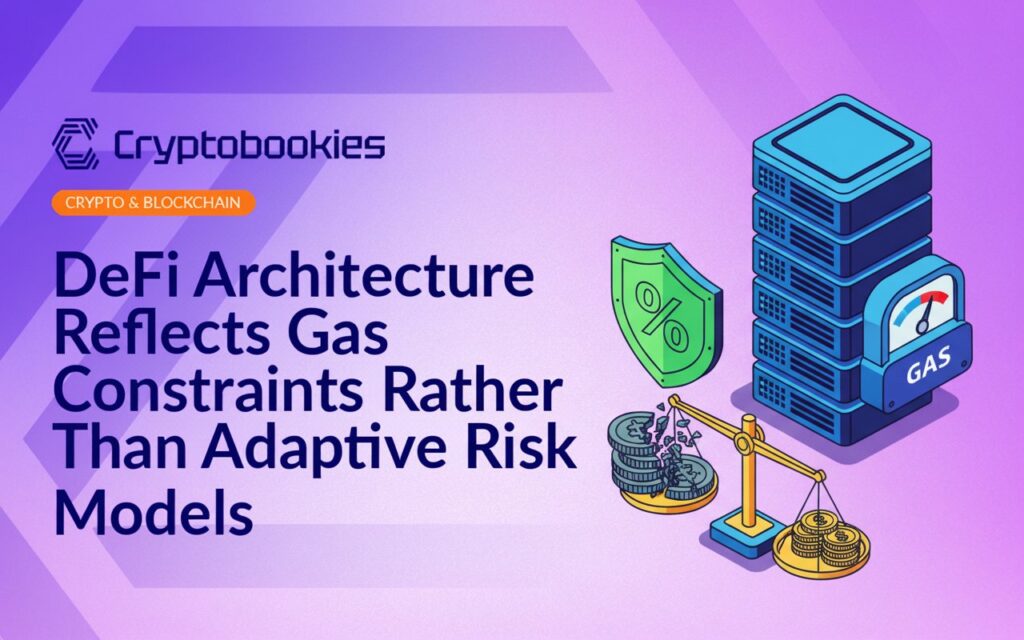
DeFi Architecture Reflects Gas Constraints Rather Than Adaptive Risk Models
DeFi Prioritizes Gas Efficiency Over Market Resilience – Computational Limits Shape Risk Management Design
Key Takeaways
- Decentralized finance protocols are structured around gas efficiency rather than adaptive market risk models.
- Core risk mechanisms such as collateral ratios and liquidation engines often rely on fixed formulas instead of dynamic recalculations.
- Past stress events, including MakerDAO in 2020 and disruptions affecting Aave, Compound, and Curve, exposed limitations in on-chain risk computation.
- According to João Garcia of Cartesi, execution design constraints restrict the complexity of financial logic that can run on-chain.
- The debate centers on whether more advanced computational environments are required for DeFi to scale responsibly.
Why Gas Optimization Shapes DeFi Architecture
Decentralized finance presents itself as a transparent alternative to traditional financial infrastructure. However, according to João Garcia, DevReal lead at Cartesi, the underlying design of many DeFi systems reflects the computational limits of blockchain environments rather than purely financial considerations.
On networks such as Ethereum, transaction execution costs, known as gas fees, influence how complex smart contracts can be. Floating point arithmetic is absent or must be emulated. Iterative simulations and repeated recalculations of cross asset exposure are computationally expensive. As a result, financial logic is often simplified into deterministic and cost efficient forms.
In practice, this means that risk parameters in lending and derivatives protocols tend to remain static. Collateral thresholds may adjust, but usually through governance processes rather than automatic recalibration based on market conditions. Liquidation mechanisms typically rely on fixed ratios instead of models that dynamically account for volatility or changing correlations between assets.
Garcia argues that this structure is not necessarily a deliberate preference for simplicity. Instead, it reflects the technical constraints of virtual machine execution environments where computation must remain affordable.
Market Stress Events Highlight Structural Constraints
Several market events cited in the article illustrate how these design choices function under pressure.
During MakerDAO’s Black Thursday event in March 2020, vaults were liquidated at effectively zero bids as auction mechanics struggled amid collapsing prices and network congestion. In subsequent downturns, lending protocols such as Aave and Compound relied on mass liquidations triggered by fixed collateral ratios rather than continuously updated portfolio models.
In 2023, Curve experienced instability following a smart contract exploit. The disruption extended beyond the affected pools. Lending protocols that accepted Curve liquidity provider tokens as collateral treated them as static assets. According to the article, this contributed to broader systemic stress.
In each case, the core issue was not the concept of decentralization itself. Instead, Garcia points to rigid financial logic operating within execution layers that could not continuously recompute risk as market conditions deteriorated.
Contrast With Traditional Financial Infrastructure
The article contrasts DeFi architecture with traditional financial markets. Banks and clearinghouses simulate numerous stress scenarios and recalculate exposures as volatility and correlations change. Margin requirements can adjust dynamically in response to shifting market regimes.
This adaptability is supported by substantial computational infrastructure and established numerical tools. Public blockchains, by comparison, were not originally designed for extensive iterative financial processing. Their focus on deterministic and verifiable execution limits the type of complex calculations that can be performed directly on-chain.
As markets deepen and instruments become more interconnected, the reliance on fixed thresholds and simplified liquidation engines may increase systemic sensitivity to shocks. According to Garcia, safeguards designed for efficiency can become amplifiers of stress when volatility rises.
Off-Chain Complexity and Governance Dependence
Simplifying on-chain logic does not remove financial complexity. Instead, it can shift that complexity to off-chain processes.
When risk modeling cannot be recomputed transparently within smart contracts, analytics dashboards, advisory teams, and discretionary governance decisions take on a greater role. During volatility spikes, protocols often depend on rapid human coordination to adjust parameters. Oracles and large token holders can also gain increased influence over outcomes.
The blockchain may continue to function as a settlement layer, but adaptive risk intelligence may operate outside it. Garcia describes this as a structural imbalance where apparent simplicity at the smart contract level masks a more complex operational reality behind the scenes.
Computation as a Structural Limitation
Garcia identifies execution design as the central constraint. If verifiable execution environments evolve toward more general purpose computing systems, the design space for decentralized finance could expand.
He outlines potential technical changes, including native floating point support, iterative algorithms, and access to established numerical libraries. These capabilities would allow financial models to be expressed directly rather than approximated in simplified form.
Under such conditions, lending protocols could integrate scenario based stress testing into their core logic. Margin requirements could adjust in response to observed volatility rather than governance timelines. Credit systems might recompute multivariable risk scores on-chain instead of relying on binary heuristics.
The objective, as described in the article, is not complexity for its own sake. It is to keep financial intelligence within the protocol, where users can verify and audit it transparently.
A Structural Crossroads for DeFi
According to Garcia, decentralized finance faces a structural choice. One path maintains gas optimized minimalism, preserving simplicity at the execution layer while allowing sophisticated financial logic to migrate off-chain. The other path treats computation as a core primitive and expands execution capabilities to support more adaptive systems.
If complex risk logic cannot operate on-chain, DeFi may continue to present simplified code structures while depending on discretionary actions in practice. Markets, however, will not reduce their complexity to accommodate virtual machine constraints.
Our Assessment
The article outlines a structural tension within decentralized finance between computational efficiency and adaptive risk management. Examples from MakerDAO, Aave, Compound, and Curve demonstrate how fixed parameters and simplified liquidation mechanisms function under stress. According to João Garcia, these outcomes reflect architectural constraints rather than inherent limits of decentralization. The debate centers on whether more advanced on-chain computational capabilities are required for DeFi systems to manage volatility and scale while maintaining transparent and verifiable risk models.