Tokenized RWAs Rise 589% Since 2025 Despite Crypto Pullback
Active Tokenized RWAs Jump 589% Since Early 2025 – Diversification Continues Despite Broader Crypto Market Weakness
Key Takeaways
- The market for active tokenized real world assets surged 589% from early 2025 to June 2026, according to Binance Research.
- Tokenized bonds and money market funds grew 83%, adding $6.5 billion in value.
- Tokenized stocks increased 422% in market value, with platforms such as Ondo Global Markets surpassing $1 billion in total value locked.
- Tokenized precious metals added $1.5 billion, with tokenized gold briefly exceeding $6 billion amid geopolitical uncertainty.
- Institutional initiatives include tokenized equities via xStocks and a planned tokenized deposit network by The Clearing House.
Tokenized Real World Assets Expand While Crypto Prices Decline
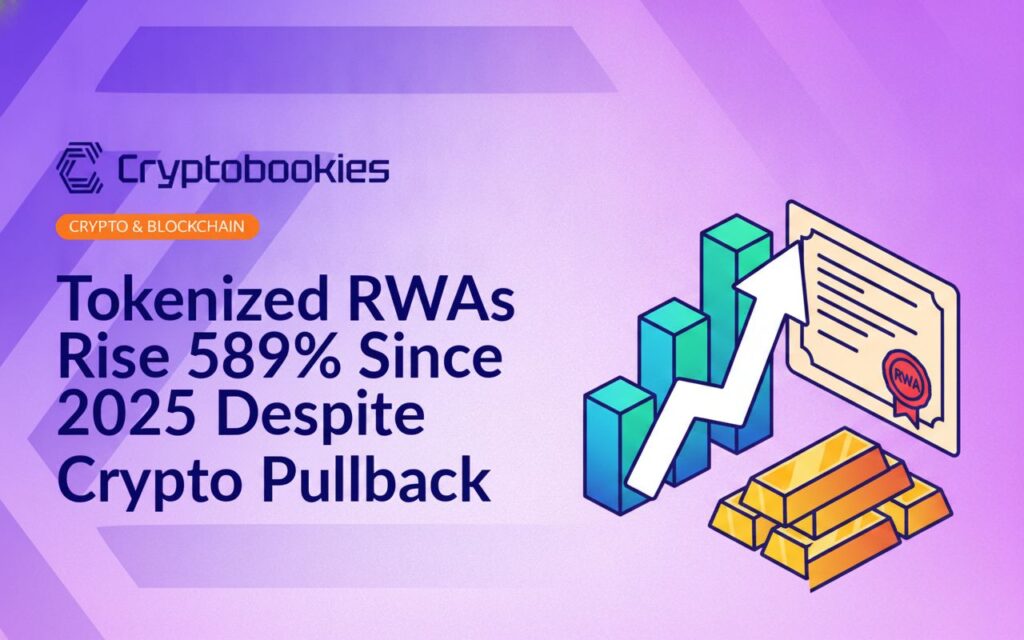
Tokenized real world assets, or RWAs, recorded significant growth over the past 18 months even as the broader cryptocurrency market faced renewed pressure. According to Binance Research in its latest Monthly Market Insights report, the value of active tokenized RWAs rose 589% between early 2025 and June 2026.
This expansion took place during a period marked by macroeconomic headwinds and policy uncertainty. In early June, Bitcoin and the wider crypto market declined sharply. Binance Research attributed the downturn to rising expectations of higher interest rates, uncertainty surrounding the CLARITY market structure bill in the United States, and shifting market sentiment following Strategy’s sale of 32 Bitcoin.
Against this backdrop, tokenized assets linked to traditional financial instruments continued to attract capital. The data indicates that investors maintained interest in blockchain based representations of bonds, equities, precious metals and other real world exposures, even as crypto native assets faced volatility.
Bonds and Money Market Funds Lead in Dollar Growth
In absolute dollar terms, tokenized bonds and money market funds accounted for the largest share of new value. The segment grew 83% during the period and added $6.5 billion in value.
This growth reinforces the role of yield focused instruments within the tokenization market. Binance described 2026 as a year in which RWA tokenization matured from what it called a Treasury dominated narrative into a more diversified yield ecosystem. The figures show that while government debt related products remain significant, they are no longer the sole driver of expansion.
For users of crypto platforms, including those who evaluate blockchain based financial services, the development highlights a shift toward assets that mirror conventional fixed income products but are issued and settled on blockchain infrastructure.
Tokenized Stocks and ETFs Record Rapid Percentage Gains
While bonds led in total dollar additions, tokenized stocks recorded faster percentage growth. According to Binance Research, the market value of tokenized equities rose 422% over the same timeframe.
A notable contributor to this increase was Ondo Global Markets. The platform, which offers tokenized stocks and exchange traded funds, surpassed $1 billion in total value locked within eight months of launch. The rapid accumulation of assets suggests growing demand for onchain access to traditional equity exposures.
Interest in tokenized equities also extended to high profile private companies. The launch of tokenized SpaceX shares drew additional attention to the sector. Kraken now provides access to a tokenized equivalent of the private company’s stock through the xStocks tokenized equities platform. According to the reported figures, xStocks reached more than $25 billion in cumulative trading volume within about eight months of its launch.
These developments indicate that tokenized equities are moving beyond niche experimentation and are being integrated into trading environments used by both retail and institutional participants.
Tokenized Precious Metals Benefit From Safe Haven Demand
Tokenized precious metals also posted measurable gains. The sector added $1.5 billion in value, representing 39% growth during the observed period.
Most of the increase occurred in January and February, when geopolitical uncertainty supported demand for safe haven assets. During that phase, tokenized gold exceeded $6 billion in value before momentum cooled and underlying gold prices retraced.
The data shows that tokenized commodities can reflect shifts in broader macroeconomic sentiment, similar to their traditional counterparts. For market participants using blockchain infrastructure, tokenized gold and other metals provide exposure that responds to the same external drivers as conventional markets.
Institutional Infrastructure Expands Beyond Investment Products
Adoption trends extend beyond tokenized investment instruments. Institutional initiatives are increasingly targeting financial infrastructure and settlement systems.
In real estate, Apex Group has begun providing fund services using Goldman Sachs’ Digital Asset Platform. The move underlines demand for blockchain based settlement and administration processes in fund management.
At the banking level, efforts are underway to modernize payments using tokenization. According to The Wall Street Journal, The Clearing House, a bank owned payments operator backed by JPMorgan Chase, Citibank, Bank of America, BNY and Wells Fargo, plans to launch a tokenized deposit network next year. The initiative represents a step toward integrating tokenized deposits into the traditional banking system and reflects competitive pressure from the growth of stablecoins.
Together, these measures indicate that tokenization is being explored not only as an investment wrapper but also as a structural component of financial market infrastructure.
Our Assessment
The reported 589% rise in active tokenized RWAs since early 2025 demonstrates sustained expansion in blockchain based representations of bonds, equities, precious metals and other assets, despite broader crypto market declines in mid 2026. Growth has diversified beyond Treasuries into stocks, ETFs and commodities, while institutional actors are extending tokenization into fund services and deposit networks. The data points to increasing integration between traditional financial instruments and blockchain infrastructure, supported by both retail trading platforms and bank backed initiatives.