UNI Rises 22% After Standard Chartered Sets $100 Target
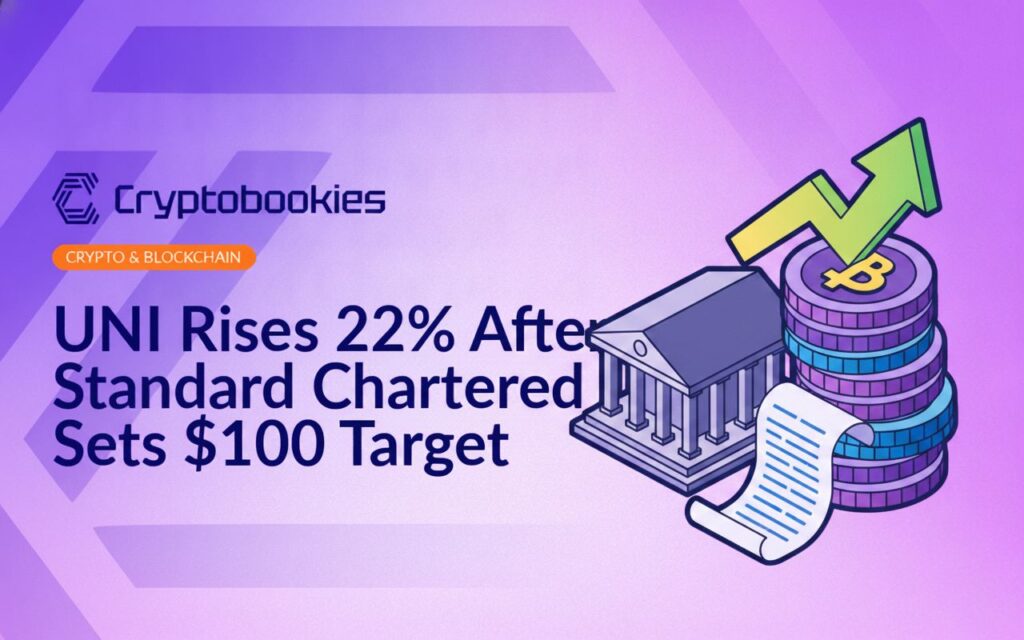
UNI Jumps 22% in 24 Hours to $3.28 – Surge Follows Standard Chartered $100 Long-Term Target
Key Takeaways
- UNI rose 22% in 24 hours to $3.28, with $621 million in trading volume.
- The move ranked in the 100th percentile of recent 24-hour price changes tracked by CoinGecko.
- Standard Chartered set a $100 end-2030 price target for UNI on June 15.
- Uniswap recorded $1.47 billion in 24-hour DEX volume across V3 and V4, according to DefiLlama.
- The UNIfication fee switch redirects protocol fees to buy and burn UNI, reducing circulating supply.
UNI Records Strongest 24-Hour Move in Recent CoinGecko Tracking
Uniswap’s native token UNI climbed 22% within 24 hours to reach $3.28 on Tuesday, accompanied by $621 million in trading volume. According to the reported data, this price increase ranked in the 100th percentile of recent 24-hour price changes tracked by CoinGecko. In practical terms, no other 24-hour window in the available dataset showed a larger percentage gain for UNI.
The session stood out not only for the magnitude of the price move but also for the scale of activity. UNI’s volume-to-market-cap ratio reached 0.30, based on a reported market capitalization of $2.04 billion. This ratio indicates that trading activity represented a significant share of the token’s overall valuation during the session.
Over the past seven days, UNI has gained 31%. Despite the recent rally, the token remains approximately 93% below its 2021 all-time high of $44.92.
Standard Chartered Sets $100 Target for End of 2030
The price surge followed the publication of a new research outlook by Standard Chartered Global Research on June 15. The bank set a long-term price target of $100 for UNI by the end of 2030.
At the current price of $3.28, that target implies an increase of roughly 30 times from present levels. To reach $100 by December 2030, UNI would need to grow at an annual compound rate of approximately 135% over four years. The recent 24-hour rally does not materially change that long-term requirement, but it aligns with the direction outlined in the bank’s thesis.
Standard Chartered framed Uniswap as a potential trading infrastructure layer for tokenized real-world assets. The report provided institutional context for a token that had traded below $3 for most of 2026 prior to this move.
No public statement was issued by Uniswap Labs or the Uniswap Foundation in response to the price action.
Protocol Activity Shows Elevated On-Chain Volumes and Fees
The market move occurred alongside elevated protocol-level activity. According to DefiLlama, Uniswap’s combined V3 and V4 deployments recorded $1.47 billion in decentralized exchange volume over 24 hours, ranking it as the top DEX entry on the platform’s list for that period.
Uniswap V4 alone generated $734,000 in fees over the same 24-hour window. Total value locked in V4 stood at $895 million. When combining V3 and V4 deployments, total value locked exceeded $2.3 billion.
These figures provide context for traders assessing whether price movements are supported by underlying usage metrics. For crypto market participants, including those who rely on decentralized exchanges for token swaps related to betting or gaming activity, DEX volume and fee generation can serve as indicators of liquidity and platform utilization.
UNIfication Fee Switch Introduces Ongoing Supply Reduction Mechanism
An additional structural factor is the UNIfication fee switch, approved by governance in December 2025 with 99.9% support. The mechanism redirects a portion of protocol fees toward purchasing and burning UNI on a continuous basis.
By reducing circulating supply over time, the fee switch alters the token’s supply dynamics. The buy-and-burn mechanism operates as an ongoing process rather than a one-time event. In combination with renewed institutional coverage, this supply-side component forms part of the broader context in which the recent rally occurred.
For market participants evaluating UNI, including users of crypto-native platforms that depend on decentralized liquidity infrastructure, such governance-driven changes can influence token economics and long-term supply trajectories.
Market Context for Crypto Users and Platform Evaluators
For international users who interact with decentralized exchanges directly or indirectly through crypto betting and gaming platforms, UNI’s price volatility highlights the sensitivity of governance tokens to research coverage, protocol metrics, and structural changes.
The reported volume-to-market-cap ratio of 0.30 distinguishes the session from low-liquidity price swings. At the same time, the gap between the current price and the 2021 peak of $44.92 underscores the scale of previous market cycles.
While short-term price movements can influence trading strategies, longer-term targets such as Standard Chartered’s 2030 projection depend on sustained growth, continued protocol usage, and the effective implementation of mechanisms like the UNIfication fee switch.
Our Assessment
UNI’s 22% rise to $3.28, supported by $621 million in trading volume, represents the strongest 24-hour gain in recent CoinGecko tracking. The move followed Standard Chartered’s publication of a $100 end-2030 price target and occurred alongside $1.47 billion in 24-hour DEX volume and active fee generation on Uniswap V4. The UNIfication fee switch, which directs protocol fees to buy and burn UNI, adds a structural supply component to the current market environment. Together, these factors define the factual backdrop of the latest price surge.