WLFI Introduces 6-Month Lock-Up for Governance Voting
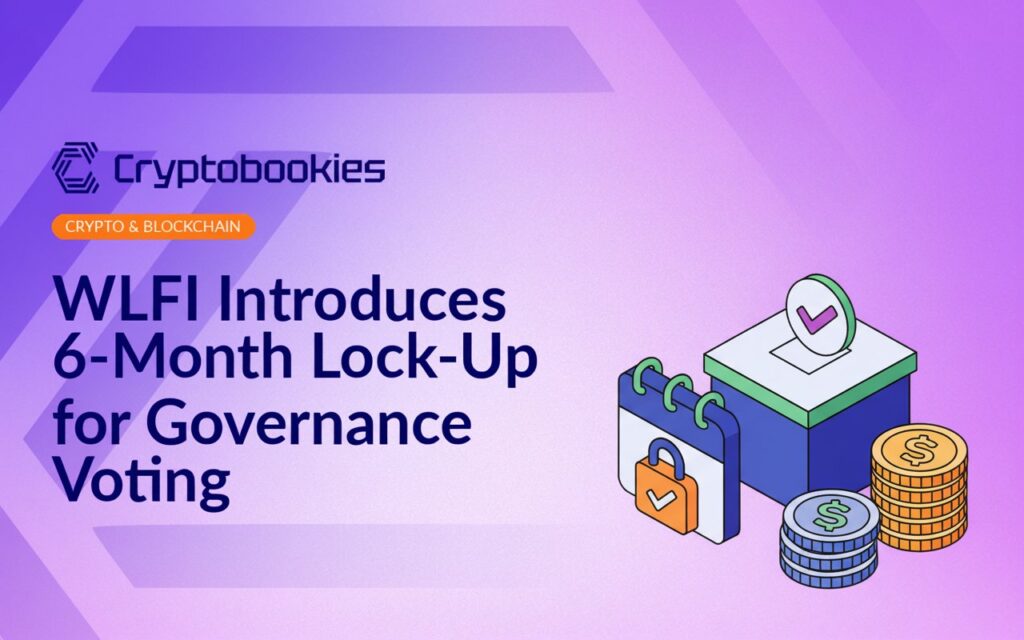
WLFI Approves 6-Month Token Lock-Up for Voting – Governance Rights Now Linked to Staking Commitment
Key Takeaways
- WLFI token holders must lock their tokens for at least 180 days to retain voting rights.
- The governance proposal passed with 99.12% approval from 1,800 votes.
- More than 76% of the participating tokens were controlled by ten users.
- Stakers can earn a 2% annual yield if they vote in at least two governance proposals during the lock-up period.
- Large stakers holding 50 million WLFI tokens may receive direct access to the WLFI business development team.
WLFI Links Voting Rights to 180-Day Staking Requirement
World Liberty Financial (WLFI) has approved a governance change that requires token holders to stake their tokens for a minimum of 180 days in order to retain voting privileges. The proposal closed on Friday with 99.12% of the 1,800 votes cast in favor, according to the project’s snapshot governance results.
Under the new rule, holders who want to participate in protocol decision-making must lock their WLFI tokens for nearly six months. Users who already have tokens locked are not affected and can continue to vote without additional requirements.
WLFI stated that the purpose of the change is to ensure that governance decisions are made by participants who demonstrate long-term alignment with the protocol. By tying voting rights to a defined staking period, the project shifts governance influence toward holders willing to commit capital for an extended timeframe.
Token Concentration and Participation Structure
Although the proposal passed with an overwhelming majority, voting data shows a concentration of influence among a limited number of participants. More than 76% of the tokens involved in the vote were controlled by ten users.
In total, 1,800 votes were cast. The distribution of voting power highlights how governance outcomes can be shaped by large token holders when participation is unevenly distributed.
Low voter turnout has been identified as a recurring issue across decentralized autonomous organizations. Estimates referenced in the report suggest that average participation rates across DAOs typically range between 15% and 25%. WLFI’s adjustment introduces a structural requirement rather than relying solely on voluntary engagement.
The broader governance debate continues across the industry. Ethereum co-founder Vitalik Buterin recently suggested that AI-based personal assistants could support DAO members in voting, potentially improving participation rates. Separately, Aave founder Stani Kulechov has proposed reducing the weight of token holder votes in favor of stronger leadership input. WLFI’s staking requirement represents a different mechanism aimed at reinforcing commitment rather than adjusting governance weight or automation.
Staking Incentives: 2% Yield for Active Participation
To encourage compliance with the new lock-up structure, WLFI is offering a 2% annual percentage yield on staked tokens. However, eligibility for this yield requires participation in at least two governance votes during the 180-day lock-up period.
This structure links financial incentives directly to governance engagement. Token holders who stake but do not vote at least twice during the period would not qualify for the stated yield benefit.
The combination of locked capital and required participation creates a two-layer system. Holders must commit liquidity and actively vote in order to maximize benefits under the new framework.
Access for Large Stakers and Clarification from WLFI
The approved proposal also outlines additional provisions for large token holders. Participants who stake 50 million WLFI tokens, valued at approximately 5 million dollars according to the report, may receive guaranteed direct access to the WLFI team for collaboration opportunities.
However, WLFI spokesperson David Wachsman clarified that this access applies to the business development team and executives rather than specific founders. In a separate statement, he added that such access does not guarantee a partnership.
The WLFI Gold Paper identifies Eric Trump and Barron Trump as co-founders and members of the team supporting the WLF commitment. Zach and Alex Witkoff are also listed as co-founders. The clarification distinguishes operational access from direct engagement with individual founders.
WLFI’s Broader Strategic Plans
WLFI is developing a crypto-enabled financial ecosystem centered around its stablecoin, USD1. According to its Gold Paper, the project aims to support other decentralized finance applications and stablecoins that seek to preserve the US dollar’s status.
In January, WLFI applied to the Office of the Comptroller of the Currency for a national trust bank charter to expand the use of USD1. A decision is still pending. The project has also introduced rewards programs and partnerships with institutional platforms and other protocols to promote USD1 adoption.
CEO Zach Witkoff has referenced potential tokenization initiatives involving assets such as real estate and oil and gas. The project is also exploring the creation of a publicly traded company that would hold WLFI tokens.
To date, WLFI has conducted six snapshot governance votes. Previous proposals included using unlocked WLFI tokens to support the growth of USD1 and making the governance token tradable.
Our Assessment
WLFI has formally connected governance participation to a mandatory 180-day staking commitment, backed by a 2% annual yield incentive tied to voting activity. The approved change concentrates influence among holders willing to lock capital, while also introducing structured engagement requirements. At the same time, voting data shows that a limited number of large token holders continue to represent a significant share of governance power. The proposal aligns governance rights with staking duration as WLFI advances its broader plans around USD1, regulatory licensing, and tokenization initiatives.