Australia Fines Binance Unit $6.9M Over Client Misclassification
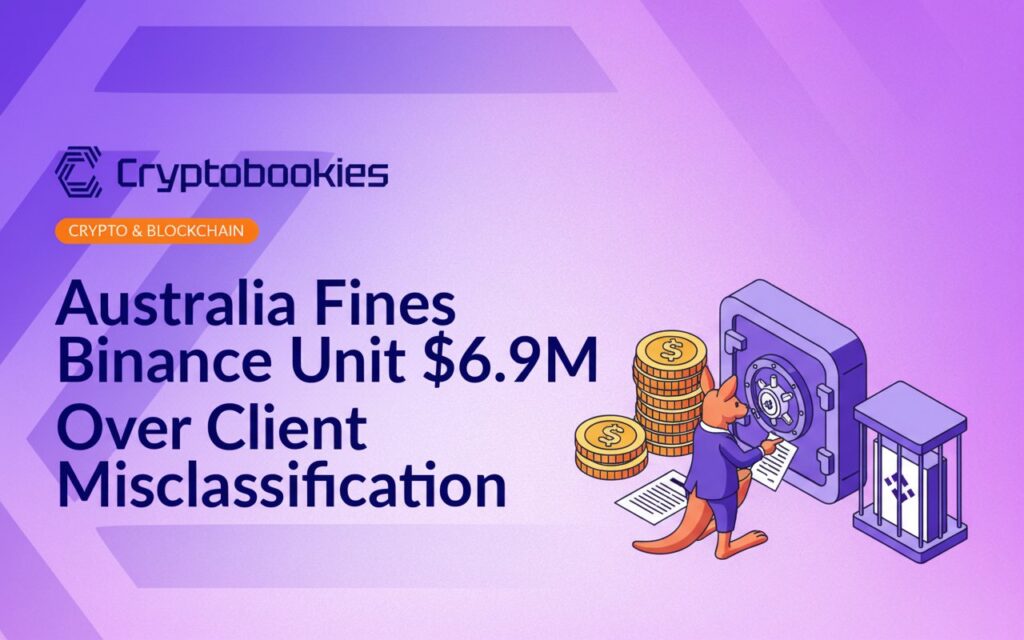
Australia Orders $6.9 Million Fine Against Binance Australia Derivatives – Court Cites Retail Client Misclassification and Compliance Failures
Key Takeaways
- The Federal Court of Australia fined Binance Australia Derivatives 10 million Australian dollars, equivalent to $6.9 million.
- More than 85 percent of its Australian clients were misclassified, affecting 524 retail investors between July 2022 and April 2023.
- Those clients incurred $6.3 million in trading losses and paid $2.6 million in fees.
- The penalty follows approximately $9 million in compensation paid to affected users in November 2023.
- The company admitted to multiple compliance failures, including inadequate onboarding and staff training.
Federal Court Imposes Financial Penalty on Binance Australia Derivatives
The Federal Court of Australia has ordered Oztures Trading Pty Ltd, operating as Binance Australia Derivatives, to pay a 10 million Australian dollar penalty, equivalent to $6.9 million. The ruling follows admissions by the company that it misclassified the majority of its Australian customer base and failed to meet several regulatory obligations.
According to the Australian Securities and Investments Commission, the violations occurred between July 2022 and April 2023. During that period, 524 retail investors were incorrectly categorized as wholesale clients. This classification allowed them to access crypto derivatives products that carry higher risk and are subject to stricter regulatory safeguards when offered to retail investors.
ASIC stated that more than 85 percent of Binance Australia Derivatives’ local clients were misclassified. As a result, affected investors recorded combined trading losses of $6.3 million and paid $2.6 million in fees.
Misclassification Enabled Access to High Risk Derivatives Products
Under Australian financial services rules, retail and wholesale clients are treated differently. Retail clients are entitled to additional protections, including product disclosure statements and formal target market determinations. Wholesale clients, often referred to as sophisticated investors, can access a broader range of complex financial products with fewer mandatory disclosures.
Binance admitted in a statement of agreed facts that 460 of the 524 affected users were incorrectly classified as sophisticated investors. A further 33 were wrongly categorized as meeting the individual wealth test.
The company acknowledged that its onboarding process allowed clients to make unlimited attempts at a multiple choice quiz designed to assess whether they qualified as sophisticated investors. Users could retake the test until they achieved a passing score, enabling them to obtain wholesale status.
ASIC said senior compliance staff at Binance Australia Derivatives provided inadequate oversight of client applications. This weakened internal controls and contributed to systemic misclassification.
ASIC Chair Joe Longo described the case as a clear warning to global financial services entities seeking to operate in Australia, stating that the shortcomings exposed a large portion of the company’s Australian customer base to products they should not have been able to access.
Compliance Failures Beyond Client Classification
In addition to misclassifying clients, Binance Australia Derivatives admitted to several other regulatory breaches. The company failed to provide product disclosure statements to retail clients and did not make a target market determination, both of which are required under Australian financial services regulations.
It also acknowledged that it did not maintain a compliant internal dispute resolution system. Furthermore, the company failed to comply with certain conditions attached to its Australian Financial Services licence and did not adequately train its employees.
These compliance deficiencies formed part of the agreed facts submitted to the court. The penalty ordered by the Federal Court reflects the cumulative nature of these failures rather than a single procedural breach.
Previous Compensation and Licence Cancellation
The court imposed the 10 million Australian dollar penalty in addition to compensation already paid to affected users. In November 2023, Binance’s local derivatives unit paid approximately $9 million to impacted clients.
A Binance spokesperson stated that the issue had been self identified, reported to ASIC, and fully remediated in 2023. The spokesperson confirmed that the compensation was paid in November 2023.
Regulatory action against the company began earlier. In April 2023, ASIC cancelled Binance Australia Derivatives’ licence following a review of its operations, including its retail and wholesale client classification practices.
The latest court order formalizes the financial consequences of those earlier findings and admissions.
Separate AML Action Against Binance Linked Entity
The ruling follows another regulatory action involving a Binance linked entity in Australia. In August 2025, the Australian Transaction Reports and Analysis Centre took action against Investbybit Pty Ltd. That entity was ordered to appoint an external auditor in relation to Anti Money Laundering and Counter Terrorist Financing concerns.
While the two matters concern different regulatory frameworks, they reflect ongoing scrutiny of crypto related businesses operating within Australia’s financial system.
For users of crypto derivatives platforms, including those considering offshore or international providers, the case highlights how client classification determines access to certain products and the level of regulatory protection applied.
Our Assessment
The Federal Court’s decision establishes that Binance Australia Derivatives misclassified more than 85 percent of its Australian clients and failed to meet multiple regulatory requirements. The company has paid $9 million in compensation and must now pay an additional 10 million Australian dollar penalty. The case resulted in the cancellation of its Australian licence and forms part of broader regulatory oversight of crypto related entities in the country.