BC.GAME Updates $BC White Paper With Expanded Utility Details
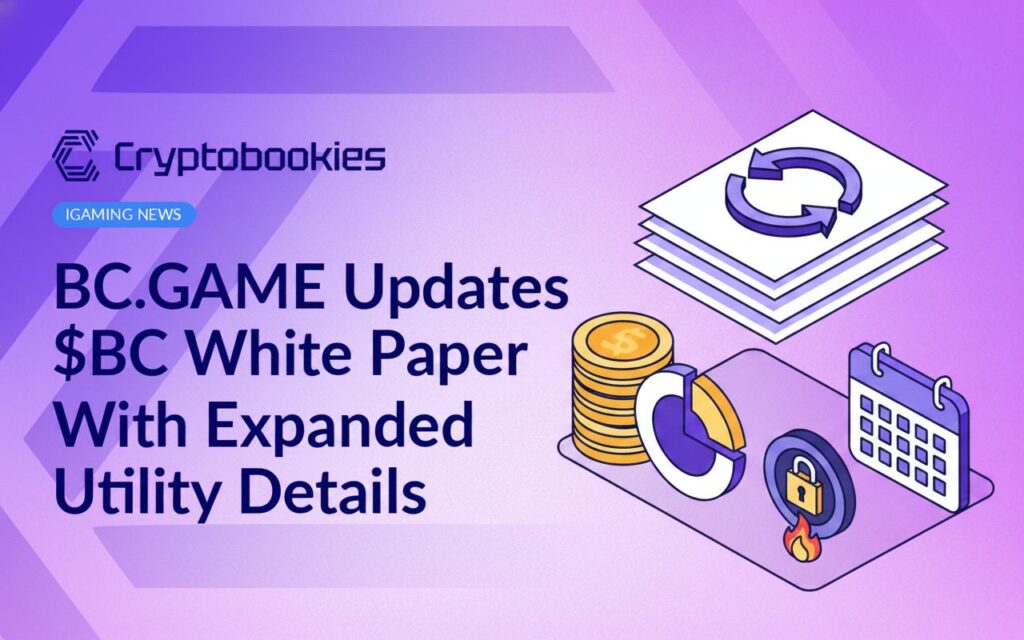
BC.GAME Releases Updated $BC White Paper – Expanded Token Utility and Staking Rules Clarified
Key Takeaways
– BC.GAME has published a revised white paper detailing the utility of its native $BC token within the platform.
– The document outlines a fixed total supply of 10 billion $BC and explains allocation categories such as liquidity mining, community airdrops, LDP, advisors, and marketing.
– The update introduces clearer rules for BC Engine staking, including a 1% burn on early unstaking before seven days.
– The burn mechanism links staking behavior directly to token supply management.
– The white paper positions $BC as a utility token integrated into platform activity rather than separate from the product.
Updated White Paper Defines the Role of $BC Within the Platform
BC.GAME has released an updated version of its $BC white paper, providing additional detail on how the token functions inside the platform ecosystem. According to the document, $BC is designed as a utility token tied to real activity on BC.GAME rather than as a standalone digital asset detached from platform use.
The revised paper explains that players can use $BC across several gaming related functions. These include staking, rewards, trading, exclusive access features, and community contributions. By outlining these use cases, BC.GAME clarifies how token ownership connects to participation in the platform’s broader environment.
For users evaluating crypto based gaming platforms, token utility is a central factor. The updated document focuses on describing how $BC integrates with daily platform activity, aiming to make the functional role of the token more transparent.
Fixed Supply and Allocation Structure Detailed
The white paper confirms a fixed total supply of 10 billion $BC. In addition to stating the maximum supply, the update sets out how this supply has been allocated across different categories.
The allocation framework includes liquidity mining, community airdrops, LDP, advisors, and marketing. By breaking down these categories, BC.GAME provides greater visibility into how tokens have been distributed and reserved.
Clear allocation data is relevant for users who assess token based ecosystems in the iGaming sector. Understanding how supply is divided between community incentives and internal allocations can influence how participants evaluate reward structures and long term platform mechanics.
BC Engine Staking Model and Early Unstaking Rules
A central element of the update concerns BC Engine, the platform’s staking mechanism. Players who stake $BC into BC Engine participate in the platform’s staking model, which links token holding to rewards and platform engagement.
The revised white paper introduces a specific rule for early unstaking. If a player withdraws staked $BC before a seven day period has passed, 1% of the unstaked amount enters the burn process. This rule connects staking behavior directly to token supply management.
The burn mechanism is designed to remove a portion of tokens from circulation when early unstaking occurs. As described in the document, this structure integrates staking incentives and supply control within the same framework. Rather than treating staking rewards and supply adjustments as separate processes, BC.GAME links them through BC Engine.
For users, this means that decisions about how long to stake tokens have defined consequences. Early exits trigger a measurable reduction in supply through the burn mechanism, while longer staking periods avoid that specific penalty.
Integration of Rewards, Participation, and Supply Management
The updated white paper emphasizes that $BC is intended to function as part of the BC.GAME experience. The document describes how token utility, reward mechanisms, staking behavior, and supply management operate together.
According to the company, this integrated approach is meant to provide a clearer explanation of how different elements of the ecosystem interact. Rewards are tied to participation, staking influences supply dynamics, and platform activity underpins token use cases.
The stated objective is to align token mechanics with actual platform engagement. By outlining these connections in detail, BC.GAME aims to define how long term participation and token holding interact within its system.
In a statement included with the update, BC.GAME CEO KK said that $BC is designed to be part of the platform experience rather than separate from it. The updated white paper, he said, is intended to clarify how utility, rewards, staking behavior, and supply management are connected through BC Engine and broader platform activity.
Why This Update Matters for Crypto Gaming Users
For users of crypto based gaming platforms, white papers serve as primary documentation for token structure and platform economics. The revised $BC white paper provides more explicit information about supply limits, allocation categories, staking conditions, and burn mechanics.
In practical terms, this allows players and token holders to review how staking decisions affect token supply and how different allocation segments are defined. It also clarifies that $BC is positioned as a utility token embedded in the operational framework of BC.GAME.
As crypto integrated iGaming platforms continue to rely on native tokens for rewards and participation models, documentation that defines token mechanics in detail plays a central role in user evaluation and comparison.
Our Assessment
BC.GAME’s updated $BC white paper sets out a fixed supply of 10 billion tokens, clarifies allocation categories, and defines how BC Engine staking interacts with a 1% burn on early unstaking before seven days. The document presents $BC as a utility token embedded in platform functions such as staking, rewards, trading, exclusive access, and community participation. The update provides structured information on how token utility, staking behavior, and supply management are linked within the BC.GAME ecosystem.